
Lightspeed POS to Shopify: a retail operations platform.
A custom middleware platform that kept products, inventory, orders and fulfilment consistent across two systems that were never designed to talk to each other, with an operations dashboard so the team could see every job it ran.
- Client
- SWI Fence, US
- Industry
- Retail & distribution
- Scope
- Integrations · Shopify · Middleware
- Engagement
- 2025, 6 months
Two systems that did not talk to each other
The challenge
SWI Fence sells fencing products across retail and trade channels in the United States. Like a lot of businesses that grew into ecommerce rather than starting there, they ended up running two systems that did not talk to each other.
Lightspeed Retail held the operational truth: products, stock levels and purchase orders, the things the warehouse and the counter depend on. Shopify held the storefront. Keeping the two aligned was manual work: re-entering products, reconciling stock, chasing orders between systems. Slow, error-prone, and with an expensive failure mode: selling stock that was not there, or hiding stock that was.
Our approach
Code Pros was engaged through Dotcom Global Media, SWI's digital partner, to solve the integration properly rather than patch it.
Discovery started with the existing Lightspeed workflow rather than with the technology, mapping how stock actually moved through the business before deciding what the middleware needed to guarantee. Architecture and the API contract between systems were defined up front, then fulfilment and shipping automation scoped on top of a synchronisation layer we knew was sound.
SWI Tools: a middleware platform, not a sync script
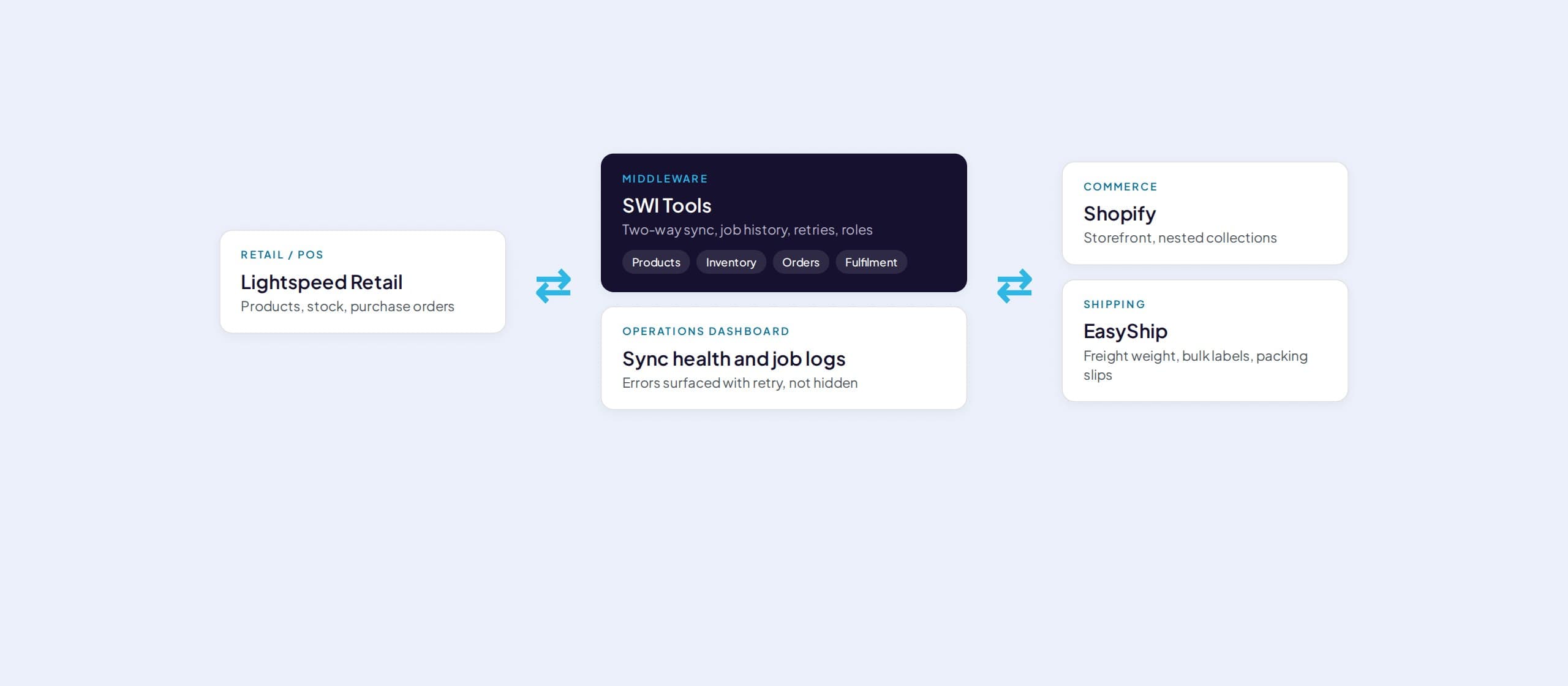
SWI Tools sits between Lightspeed Retail and Shopify, owning synchronisation in both directions and giving the internal team visibility and control over every job the system runs.
The distinction matters. This is an operations product with its own dashboard, job history, error handling and user management, built so that the people running the business can see what the integration is doing and step in when something needs attention.
- 01MiddlewareCustom REST API service
- 02CommerceShopify
- 03Retail / POSLightspeed Retail (R-Series)
- 04ShippingEasyShip
- 05Team7 engineers
- 01
Synchronisation
Bi-directional product and inventory sync, order synchronisation and processing, and fulfilment status flowing back into the operational system. Lightspeed's nested category hierarchy is mapped into Shopify collections using parent metafields, with product filtering maintained across nested levels.
- 02
Shipping and fulfilment
EasyShip integration for rate calculation and label generation, custom freight-weight calculation, bulk label generation, automatic packing slips based on box and product sizing, and drop-ship vendor automation.
- 03
Operations dashboard
Sync monitoring and system health reporting, job tracking with detailed logs, error reporting with retry mechanisms, user and role management, and configuration controls over automation behaviour.
The parts that were actually difficult
Hierarchy across two different models
Lightspeed supports genuine category hierarchies. Shopify collections are flat. Mapping one onto the other meant encoding hierarchy Shopify does not natively hold, using parent metafields, then keeping product filtering correct inside those nested collections as the catalogue changed on either side.
Freight weight on awkward goods
Fencing products are long, heavy and awkwardly shaped. Shipping cost is driven by dimensional weight and box configuration, not simply mass. Quoting accurately meant calculating freight weight per configuration rather than trusting a carrier default.
Labels and packing slips at volume
Generating shipping labels in bulk, with correct box selection per order, and packing slips that matched what was in each box. We evaluated ShipStation and chose EasyShip: it fit the rate structure and API model better for this catalogue.
Where it landed
The platform was completed and tested end to end; it did not go live because the contract between Dotcom and SWI Fence ended before launch.
The work stands as proof of a specific capability: connecting operational retail systems to ecommerce platforms without either side losing its source of truth.
- 6 monthsBuild durationMay to October 2025, across discovery, middleware, integration and fulfilment phases.
- ~499Engineering hoursA team of seven spanning backend, integrations and frontend.
- 2Systems synchronisedLightspeed Retail and Shopify, bi-directionally, plus EasyShip and drop-ship vendors.
Running two systems that don't talk to each other?
We build the integration layer between commerce platforms, operational systems and the tools your team works in, designed so neither side loses its source of truth.
Book a 20-min call